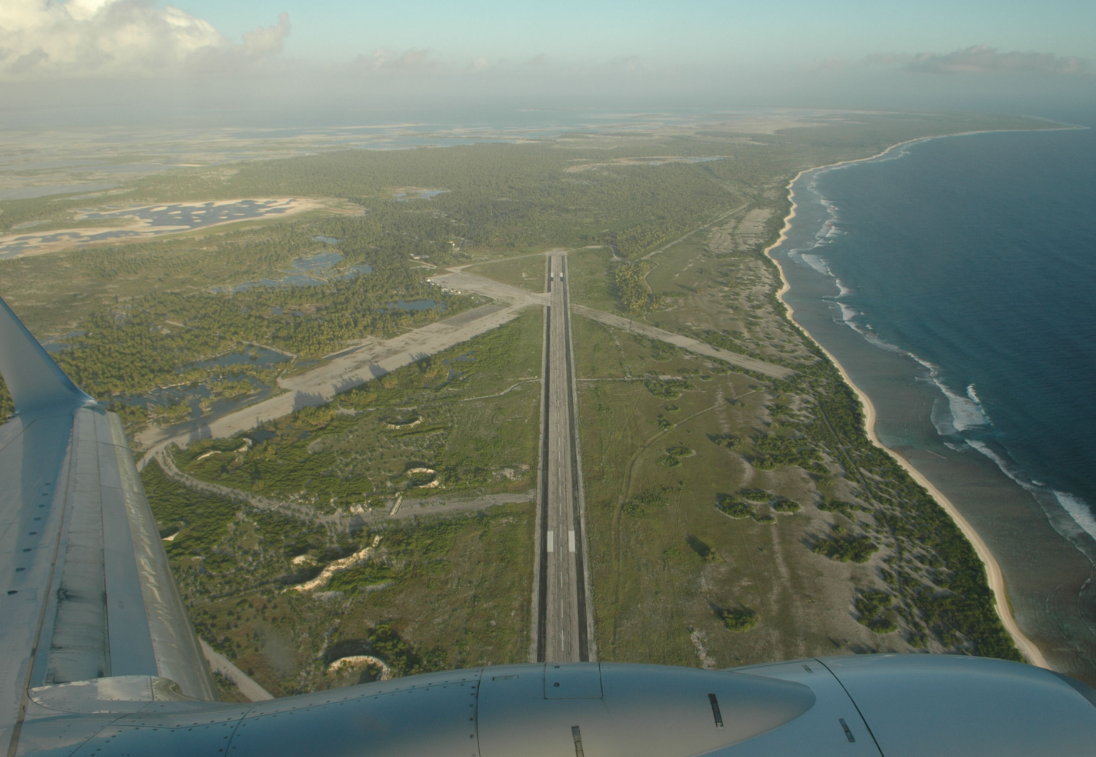

ARORAE, October 19, 2026 (BPA NEWS) — Kiribati’s southernmost island, Arorae, commemorated the 156th anniversary of the arrival of the first Samoan Protestant missionaries on October 17, 1870. The occasion took on special significance when a distinguished guest discovered a personal family connection to the island’s Christian heritage.
The anniversary celebrations, held on Saturday, brought together several prominent officials, including President Taneti Maamau, Minister for Women, Youth, Sport and Social Affairs Ruth Cross Kwansing, Abaiang MP Betero Atanibora, New Zealand High Commissioner Pati Gagau and his wife, Sera Gagau, as well as Arorae MP Niti Itaaka and his wife, Tamana Itaaka.

President Taneti Maamau was greeted with a ceremonial presidential salute by a guard of honour, followed by a traditional welcome featuring floral garlands, music from a local string band and a performance of the taubwati dance, which has its roots in the Samoan Fa’ataupati.
Following the welcoming ceremony, the visiting delegation made its way to Takoto village, located at the southern tip of Arorae, where guests gathered for lunch.
The introduction of Christianity to Arorae dates back to October 17, 1870, when Leleifotu, a Samoan missionary representing the London Missionary Society (LMS), arrived on the island. He became the first Samoan Protestant missionary to establish a permanent presence in the Gilbert Islands, now known as Kiribati.
Leleifotu travelled with Reverend Samuel James Whitmee, who left him on Arorae before continuing his missionary journey to other southern islands, including Tamana, Onotoa and Beru. This historic arrival represented a significant milestone in the early expansion of Protestant Christianity throughout the southern Gilbert Islands.
For Sera Gagau, wife of New Zealand High Commissioner Pati Gagau, the anniversary celebration carried special personal meaning. Beyond commemorating a significant historical event, the occasion marked her first visit to Arorae, her mother's birthplace, allowing her to reconnect with her family's deep-rooted missionary heritage.
Speaking as one of the invited guests, Sera reflected on the contributions of her Samoan missionary ancestors, who dedicated decades of service to communities throughout the Gilbert Islands.
Expressing her joy and gratitude, Sera said she felt deeply privileged to participate in the 156th anniversary celebrations marking Christianity's arrival on Arorae, particularly because she is the granddaughter of a missionary couple who once served on the island.
Sera Gagau traced her family's missionary roots to her great-grandfather, Kirisome, a Samoan missionary who initially served in Niue before being assigned to Kiribati. He later returned to his homeland of Samoa.
Continuing the family's religious mission, his son, who shared the name Kirisome, also became a missionary. In 1917, he moved to Arorae with his wife, Sinatala Naioti, and their family to carry on missionary work.
During their years on the island, the couple raised six children, all of whom were born on Arorae. Growing up within the local community, the children became fluent in the Kiribati language and developed the distinctive Arorae accent. Among them was Sera's mother, who was given the name Reteta by the island's residents.
The family's strong connection to Arorae was also reflected in the naming of one of Sera's maternal uncles, Tamaroa, after a village on the island.
According to Sera, her mother and her siblings spent their childhood on Arorae with their parents. The family eventually relocated to Samoa when her mother was 17, following efforts by the London Missionary Society (LMS) to encourage more I-Kiribati people to become missionaries.
Sera recalled that returning to Samoa presented a cultural and linguistic challenge for her mother and her siblings. Having spent their formative years on Arorae, they were unable to speak Samoan but communicated fluently in Kiribati and were deeply familiar with the island's traditions and way of life.
As a result, they were frequently referred to as I-Kiribati because of their strong command of the Kiribati language and their close identification with Kiribati culture.
Before departing Arorae, Sera Gagau's family made a lasting contribution to the island by forming the first brass band at Sona Primary School. They also gave the name Takoto Bwatitotai to a location at the island's southernmost point, drawing inspiration from the Samoan village of Fatitotai.

For Sera, visiting Arorae was an emotional experience, shaped by the many stories her mother had shared about the island throughout her life.
She recalled how her mother frequently spoke about her childhood and experiences on Arorae, continuing to share those cherished memories well into her later years.
Sera described her first visit as a special blessing, giving her the opportunity to personally experience the surroundings where her great-grandparents and grandparents had carried out their missionary work and where her mother had been born and spent her childhood.
She also expressed her appreciation to Arorae MP Niti Itaaka and his wife, Tamana Itaaka Tauman, for inviting her and her husband to participate in the anniversary celebrations, which held deep historical and personal significance for her family.
Sera's grandparents, Tamatoa Kirisome and his wife, Sinatala Naioti, were among the Samoan missionary couples who dedicated their lives to religious service in the Gilbert Islands during the later years of the London Missionary Society's missionary activities. The couple arrived on Arorae in 1917 and continued their missionary work on the island until 1948.
ARORAE, October 19, 2026 (BPA NEWS) — E a tia te kabanea n aba mai maiaki ae Arorae ni kauringaa koron 156 te ririki imwin moan rokon te moan mitinare n te Ekaretia ni Boretetanti mai Samoa n 17 n Okitobwa 1870, ma ana iruwa ae e rine are e a tibwa nora ao ni karoko n te aba are a bungiaki ao ni maeka iai ana ikawai.
E karaoaki te bukamaru aio n te Kaonobong ao n iiraki iroun Kautun Kiribati ae Beretitenti Taneti Maamau, te MInita ibukia Aine, Roronrikirake, Takakaro ao te Kamweraoi (MWYSSA) ae Ruth Cross Kwansing, te Tia Tei mai Abaiang ae Beteroo Atanibora, ana Ai Kamitina Nutiran ae Pati Gagau ma kain abana ae Sera Gagau, ao te Tia Tei mai Arorae ae Niiti Itaaka ma kain abana ae Tamana Itaaka.

E butimwaeaki ao n anganaki te Beretitenti karineana n te marae irouia bureitiman imwain ae bane ni butimaeaki iruwa n te katokabau n te katangitang irouia kain te string band ao te taubwati, mwaien Arorae are e nako man te mwaie n Samoa ae te Fa’ataupati.
A kaneweabaaki iruwa imwina nako Takoto i tabon te aba ike a katawanou iai.
E moan te roko ao n uotaki te oota nako Arorae n 17 n Okitobwa 1870 iroun Leleifotu, te mitinare mai Samoa man te London Missionary Society (LMS), are ngaia te moan mitinare ni kamatu mai Samoa ni maeka i Kiribati.
E roko teuaei ma Reverend Samuel James Whitmee, are e katikua i Arorae imwain ae e a manga reitanako ana mwakuri n aban te itera maiaki ake tabeua n aron Tamana, Onotoa ao Beru. Rokon teuaei ikekei e a bon mwaakena naba moan rokon ao kabutan te Aro ni Kiritian ni Boretetanti n te itera maiaki.
E ngae n anne ao iroun buun ana Ai Kamitina Nutiran ae Sera Gagau, ao e aki tii roko bwa te iruwa ma e roko ni kauringaa rongorongoia ana ikawai. E aki tii roko n iira te bukamaru ma e roko naba n nora te abamwakoro are e bungiaki iai tinana n te moan tai ao ni manga kamaiua rongorongoia ana utu ni karaoa aia mwakuri ni mitinare iaona.
Sera bon temanna mai ibuakoia iruwa ake a anga aia maroro n te botaki aei, ike e a reke iai ana tai n tibwauaa rongorongoia ana ikawai mai Samoa aika mitinare, ake a mwakuri iaon Kiribati inanon irabwii te ririki.

“I rangi ni kukurei ao ni kakatonga n iira ana ka-156 n ririki moan rokon te Ota iaon Arorae, ngkai bon ngai temanna tibuia moan taanga ni mitinare ake a mwakuri n te aba aei,” e taku neiei.
E kabwarabwara neiei bwa tibutoruna te unimwane ae Kirisome, te mitinare mai Samoa are e mwakuri iaon Niue imwain kamwaingakina nakon Kiribati ao ni manga okira Samoa imwiina.
Natin teuaei ae arana naba Kirisome, e a manga bon toua mwiin tamana ni mitinare. E roko teuaei i Arorae n 1917 ma kain abana ae Sinatala Naioti ma ana utu.
Onoman natiia te taanga aio aika a bungiaki ao n ikawai iaon Arorae ao n rangi bwaati te taetae ni Kiribati ao n ee naba n Arorae. E bungiaki naba tinan Sera iaon Arorae ao n aranaki bwa Reteta irouia kain Arorae.
E ingoanaki naba temana mwanena n aran teuana kaawan Arorae ae Tamaroa, ike e a kamatoa riki iai irekereken ana utu neiei ma te abamwakoro aei ao kaaina.
E taku neiei bwa a maeka tinana ma tarina ao mwanena ao aia karo iaon Arorae ni karokoa e koro 17 ana ririki tinana ao n okira Samoa imwin kaungakia kain Kiribati iroun te LMS bwa a nang riai n reitanako karaoan te mwakuri ni mitinare.
“Ngke a okira Samoa tinau ma tarina ao mwanena ao a kabi n taetae n Samoa ao n araranaki bwa kain Kiribati ibukina bwa a rangi ni bwaati te taetae ni Kiribati ao n rang ataa naba te katei ni Kiribati,” e taku neiei.
Imwain kitanan Arorae, ao e reke aia tai te utu aei ni katea ana moan buraati baen te reirei ae Sona Primary School. A arana naba te tabo teuana i tabon te aba ae Takoto bwa Bwatitotai – n aran kaawan Samoa ae Fatitotai.
E taku Sera bwa e rangi ni kakawaki ao ni kauringaaba rokona aio ngkai e aki toki tinana ni karakina Arorae nakoina inanon maiuna.

“I uringa tinau n aki toki ni kakarakina rongorongon Arorae ao n teimatoa ni kakarakina te aba aio ni karokoa ae e a bon kara,” e taku neiei.
“Rokou i Arorae bon te kakabwaia nakoiu ibukina bwa I a tibwa kona n nakonako, n noora, n taua ao ni maeka n te tabo are a mwakuri ngkoa iai tibutoru ao tibu ao te tabo naba are e bungiaki ao n ikawairake iai tinau.”
E karabwarabwa naba neiei nakon te Tia Tei mai Arorae ae Niiti Itaaka ma kain abana ae Tamana Itaaka Tauman ibukin kaoakina ma kain abana bwa a na ira ao ni kakoaua te bukamaru are e aranna bwa e rangi n nano ao ni kakawaki irouna ma ana utu.
Tamatoa Kirisome ma buuna ae Sinatala Naioti bon ngaiia tenaan kabanea n taanga ni mitinare mai Samoa ni mwakuri iaon Arorae. A roko n te abamwakoro aio n 1917 ao ni mwakuri iaona ni karokoa 1948.